
.png)
Chameleons
Old World chameleons are found from Spain to India, throughout Africa and Madagascar, and on many islands in the Indian Ocean. They inhabit many environments and climates and should be cared for accordingly.
temperature
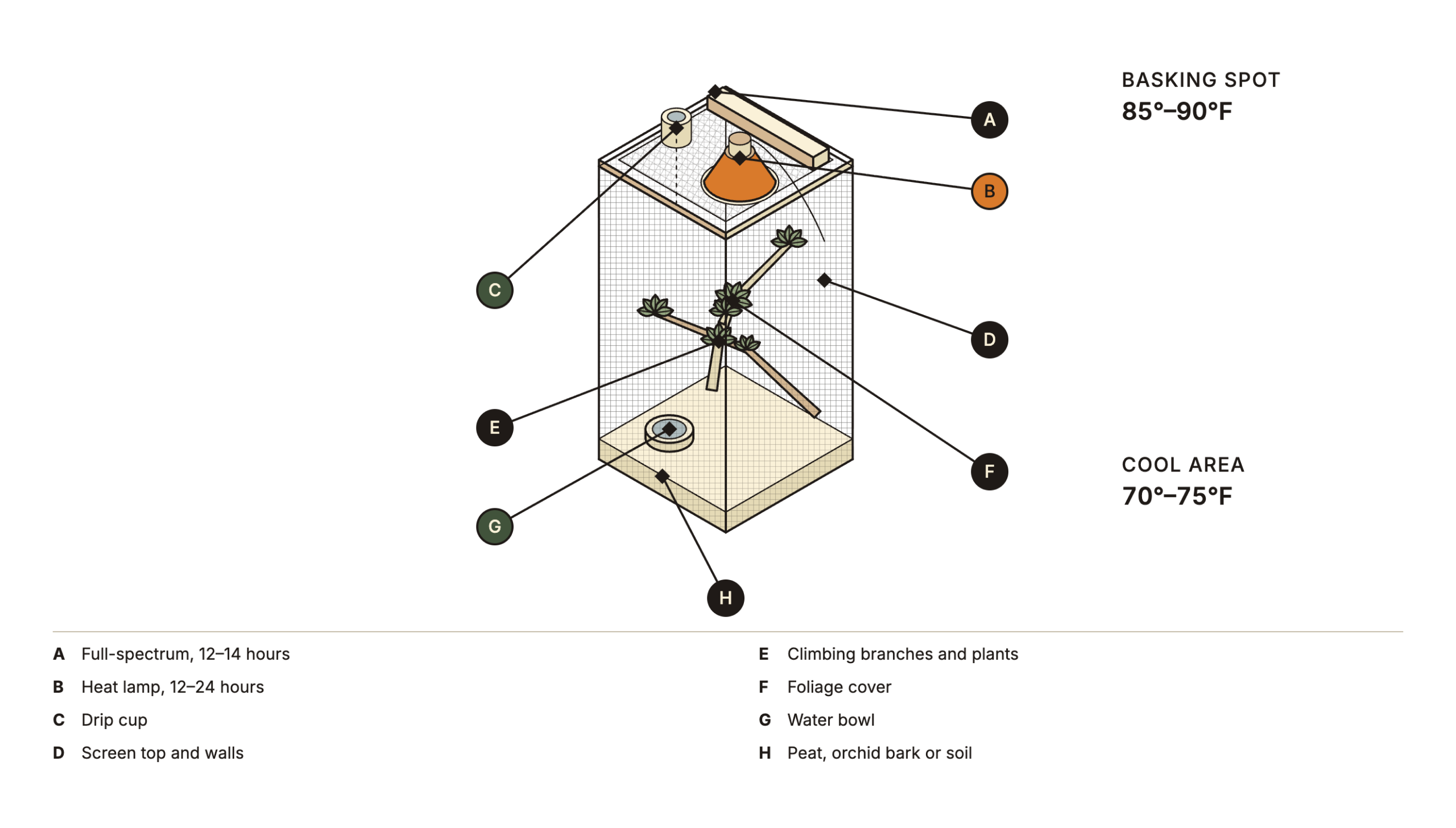
Chameleons are extremely temperature sensitive and need strong gradients. Montane and cooler-climate species: a warm basking spot of 85°–90°F. Lowland, desert and warmer-climate species: a hot basking spot of 90°–100°F. All chameleons overheat easily, so keep a cool side at 70°–75°F. Never let the cool spot exceed 75°F; your animal can become heat-stressed, dehydrated or die.
WATER & HUMIDITY
Chameleons rarely drink from bowls, though a shallow bowl with easy access in and out is fine. Mist and/or run a water dripper at least twice a day, spraying or dripping until the lizard stops drinking, without flooding the enclosure. Drip cups, misting systems and timers make this easier.
shelter & cage size
Fill the enclosure top to bottom with plenty of thin branches for climbing, plus live and/or artificial plants for cover and to catch sprayed and dripped water.
Enclosure size: well ventilated, with screen walls and/or a gentle fan. Vertical and as large as possible; the smallest chameleons need no less than a 30-plus-gallon enclosure, and it has to be large enough to hold a proper gradient. An all-screen enclosure for outdoor use is great for good-weather days and D3 absorption.
SUBSTRATE
Peat moss, coco peat or small orchid bark, kept damp for tropical species and dry for desert species. Nothing too large to swallow or pass if ingested by accident. Change it regularly.
DIET & feeding
Offer a variety of live insects: crickets, flies and their larvae, wax worms, silkworms. Some species also take leafy greens and grated vegetables and fruit. Hand feeding builds trust. Remove excess uneaten prey.
supplements
Indoor animals: lightly dust all food with a quality calcium/D3 and vitamin/mineral mix. Outdoor animals: dust every other feeding with a calcium and vitamin/mineral mix without D3. Without supplements, chameleons can develop vitamin and calcium deficiencies that can be fatal.
LIGHTING
Give chameleons as much unfiltered natural sunlight as possible, always with access to deep shade. Indoors, run a full-spectrum light for 12 to 14 hours a day in addition to any heat lamps. Full-spectrum lighting aids metabolism of key vitamins and minerals and may help prevent calcium and D3 deficiencies. Thermostats help prevent overheating; small computer fans help with ventilation.
LIGHTING OPTION 1
FAQ
Can my chameleon go outside?
Yes, and it should when the weather allows. Unfiltered sunlight is the best D3 source. Provide deep shade at all times.
What gear makes chameleon care easier?
Thermostats to prevent overheating; drip cups, misting systems and timers for water; small computer fans for airflow; and an all-screen enclosure for outdoor time.